
Appliance glass components endure harsh operational environments ranging from thermal shock inside pyrolytic oven door packs to high static load-bearing requirements in commercial refrigeration shelving. Specifying glass for household and commercial appliances requires strict validation of edge finishes, high-temperature ceramic enamels, and precision dimensional tolerances. This guide outlines technical criteria for appliance manufacturers and OEM component buyers.
Thermal Shock Demands for High-Temperature Oven Door Assemblies
Oven door assemblies typically utilize multi-pane glazing packs comprising two to four glass layers. The inner pane faces direct radiant heat inside the oven cavity, where temperatures regularly reach two hundred and fifty degrees Celsius in standard baking, and exceed four hundred and fifty degrees Celsius during pyrolytic self-cleaning cycles.
Inner oven panes must be manufactured from fully tempered low-expansion soda-lime glass or specialized heat-resistant glass engineered to withstand acute thermal differentials across the pane. The intermediate and outer panes serve as thermal insulation barriers, ensuring exterior door touch temperatures remain safe for consumers. Review detailed product specifications on our appliance glass hub.
Temperature Thresholds and Glass Substrate Selection
Selecting the appropriate glass substrate for appliance applications requires careful matching of continuous operating temperatures and localized thermal gradients. Standard thermally toughened soda-lime glass withstands continuous operating temperatures up to 200°C to 250°C and sudden thermal shock differentials of approximately 150°C, making it suitable for standard baking oven inner doors, intermediate heat shields, and outer front fascia panels.
For direct open-flame cooktops, radiant infrared cooking zones, or self-cleaning pyrolytic ovens exceeding 450°C, soda-lime glass is structurally unsuitable due to its thermal expansion coefficient. These high-heat environments demand specialized low-expansion borosilicate glass or transparent lithium-aluminosilicate glass-ceramics (zero-expansion substrates) that withstand thermal shocks exceeding 700°C without risk of fracture.
Load-Bearing and Food-Contact Standards for Refrigerator Shelves
Refrigerator shelving demands high mechanical flexural strength and food-safe surface finishes. Glass shelves must support concentrated static loads from heavy liquid containers without excessive deflection or risk of spontaneous failure at low operating temperatures.
Tempered 3.2mm and 4.0mm float glass is standard for refrigerator shelves. Perimeter edges are precision-machined with rounded C-edges or flat polished profiles to facilitate plastic frame encapsulation and ensure smooth, safe handling by consumers during refrigerator cleaning.
Dynamic Load Testing and Refrigerator Shelf Safety Certification
Refrigerator glass shelves must comply with strict mechanical load and food safety standards. Quality assurance protocols mandate uniform distributed load testing, where shelves supported along their perimeter must safely carry 15 kg to 25 kg of static weight for twenty-four hours without residual deformation or edge chipping.
Additionally, dynamic impact resistance is verified by dropping a 227-gram steel ball from a height of 300mm onto the shelf center. In the rare event of severe overload fracture, the fully tempered glass must disintegrate into fine blunt particles that remain encapsulated within the plastic spill-proof edge rim.

High-Temperature Ceramic Enameling, Masking, and Touch-Control Cut-Outs
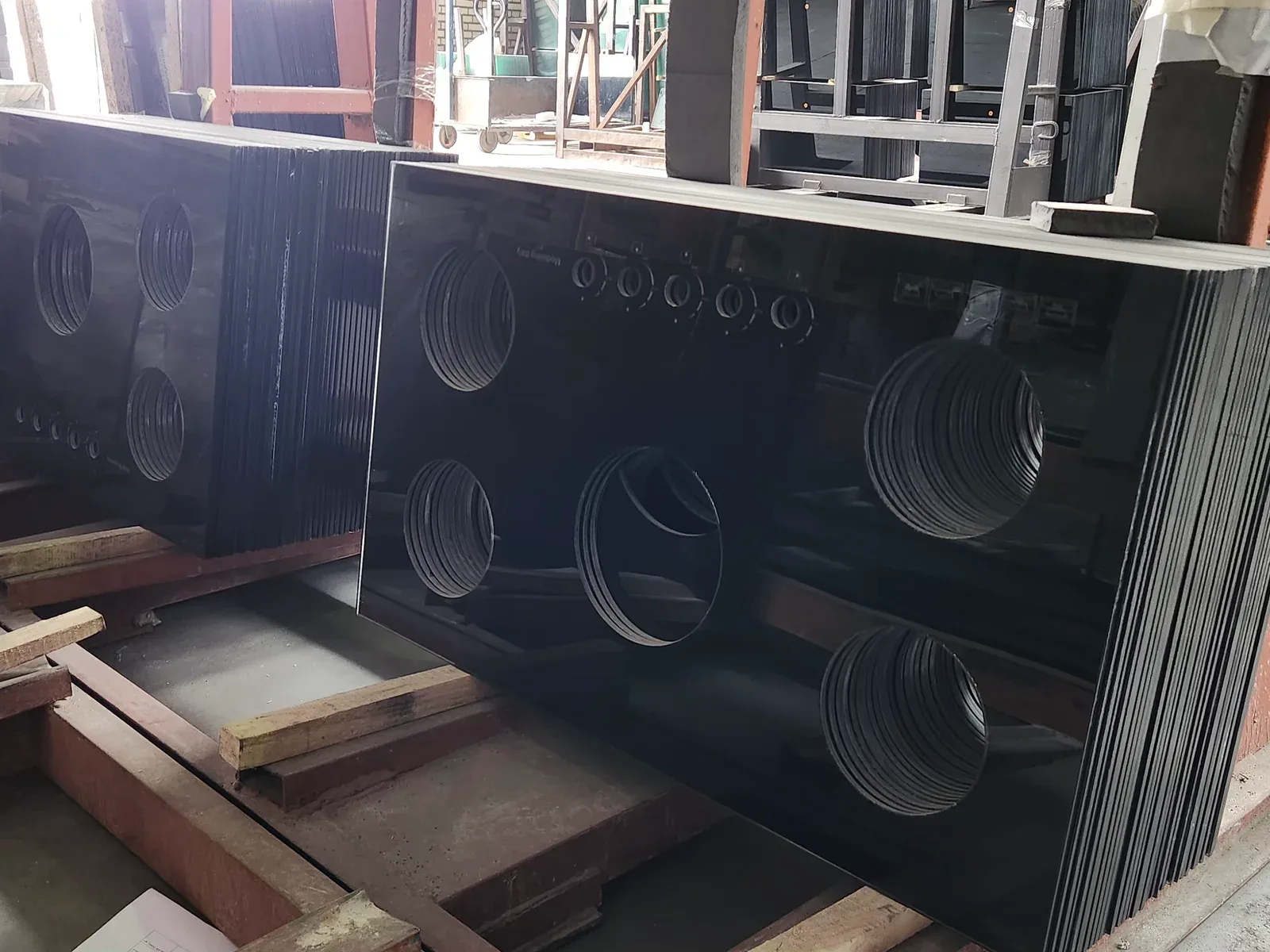
Modern kitchen appliances emphasize sleek, minimalist aesthetics featuring full-glass fascia panels with integrated capacitive touch controls. Appliance glass components are decorated using lead-free inorganic ceramic frit inks screen-printed onto the glass before thermal tempering.
The tempering process fuses the enamel permanently into the glass surface, making it impervious to steam, grease, and household chemical detergents. Translucent optical windows are masked with high precision to allow LED digital displays and touch-sensitive control icons to shine through with crisp definition.
Edge Profiles: Ground C-Edge vs Flat Polish for Frame Encapsulation
Edge finishing quality is paramount for appliance glass. Raw micro-cracks along the perimeter act as stress risers that cause glass failure when subjected to cyclic thermal expansion or heavy mechanical loads.
| Typical Thickness | Edge Finish Profile | Primary Performance Metric | |
|---|---|---|---|
| Inner Oven Door Glass | 4.0mm to 5.0mm | Flat ground with arris / smooth polish | Thermal shock resistance up to 300°C |
| Outer Oven Fascia Panel | 3.2mm to 4.0mm | High-polish flat edge with safety corners | Optical aesthetics and touch-surface flatness |
| Refrigerator Shelf Panel | 3.2mm to 4.0mm | Smooth C-edge or pencil polished | Static point-load capacity (exceeding 25kg) |
| Induction Cooktop Trim Glass | 4.0mm to 6.0mm | Bevelled or polished with radius corners | Scratch resistance and frame encapsulation |

Surface Compression and Thermal Gradient Resistance Criteria
Achieving safe thermal shock resistance in domestic oven doors demands precise control of residual surface compression during thermal tempering. While architectural tempered glass typically requires surface compression between 69 and 90 megapascals, appliance oven door panes require surface compression tightly controlled between 90 and 110 megapascals.
This heightened surface pre-stress enables inner door glass to withstand rapid localized thermal shocks—such as cold water droplets accidentally splashing onto a heated glass door operating at two hundred degrees Celsius—without initiating tensile micro-fractures.
Packaging and Anti-Scratch Protection for Appliance Assembly Lines
Appliance manufacturers operate automated assembly lines that require robotic suction-cup feeding. Glass components must arrive clean, dry, and free of adhesive residue.
Components are packed in modular steel racks or reinforced timber crates with interleaving EVA foam sheets or peelable protective film applied over sensitive ceramic printed surfaces.

Supplier RFQ Checklist for Custom Appliance Glass Components
When preparing an RFQ for appliance glass components, ensure your procurement documentation includes complete dimensional drawings and thermal specification sheets. Submit your technical package through our RFQ portal for fast engineering assessment.
- Dimensioned CAD drawings (DXF/DWG/PDF) with hole, notch, and corner radius callouts.
- Glass substrate type: clear float, low-iron ultra-clear, or body-tinted glass.
- Operating temperature profile and thermal shock test requirements.
- Ceramic frit printing artwork: Pantone or RAL color codes, opacity, and touch icon masks.
- Edge machining specification: flat polished, pencil ground, or rounded C-edge.
- Packaging preferences: bulk production line stillages versus individual protective boxing.
Frequently asked questions
What is the maximum operating temperature for tempered soda-lime oven glass?
Tempered soda-lime glass can safely operate continuously at temperatures up to two hundred and fifty degrees Celsius, with short excursions up to three hundred degrees. For higher operating temperatures exceeding four hundred degrees, specialized borosilicate or ceramic glass substrates are required.
Can appliance glass be printed with metallic or semi-transparent inks?
Yes. Specialized ceramic frit inks can produce semi-transparent mirror finishes, metallic stainless-steel effects, or varying opacity levels for hidden-until-lit LED display panels.
How is impact resistance verified for refrigerator shelving?
Refrigerator glass shelves are tested by dropping a standardized steel impact ball (typically 227 grams to 500 grams) from specified heights onto the center of the supported shelf to verify fracture resistance.
Why are rounded corners recommended on appliance glass panels?
Rounded radius corners (typically 2mm to 6mm radius) eliminate sharp point-impact stress risers, significantly reducing chipping during automated assembly handling and consumer use.
What is the touch temperature limit for oven outer door glass?
International appliance safety standards (such as IEC 60335-2-6) mandate that accessible outer oven door glass surfaces must not exceed 60°C to 70°C above room ambient temperature during normal baking operations.
Sources
- IEC 60335-2-6: Household and similar electrical appliances — Safety — Part 2-6: Particular requirements for stationary cooking ranges, hobs, ovens — International Electrotechnical Commission
- EN 12150-1: Glass in building — Thermally toughened soda lime silicate safety glass — European Committee for Standardization