
Deciphering performance datasheets for architectural insulated glass units is critical for meeting municipal building energy codes, optimizing HVAC equipment sizing, and ensuring occupant visual comfort. However, comparing datasheets across different manufacturers frequently creates confusion due to varying test boundary conditions, differing international calculation algorithms, and distinct reporting standards. This guide breaks down essential thermal, optical, and acoustic metrics.
Understanding Thermal Transmittance: Center-of-Glass vs Whole-Window U-Value
Thermal transmittance, designated as the U-value, measures the rate of non-solar conductive and convective heat transfer through a glazing system per degree of temperature difference between indoor and outdoor environments. In international specifications, U-values are expressed in watts per square meter-kelvin (W/m²K), where lower numerical values indicate superior thermal insulation.
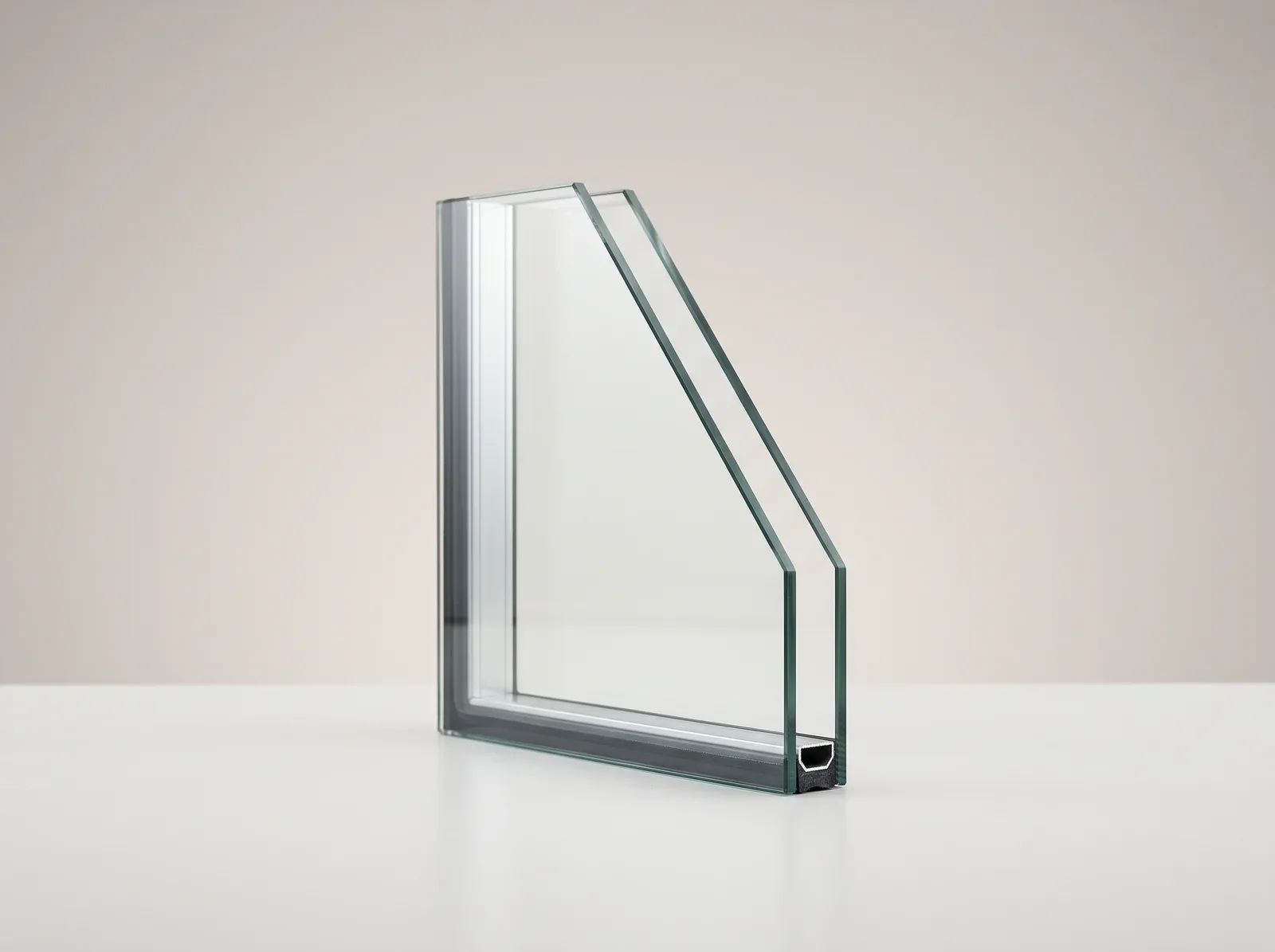
Specifiers must strictly distinguish between center-of-glass U-value (Ug) and overall whole-window U-value (Uw). Glass manufacturers publish center-of-glass data measured away from frame perimeter edge effects. The whole-window U-value incorporates the thermal conductivity of the frame profile (Uf) and the linear edge spacer thermal bridge (psi value), typically yielding a higher overall heat loss rate.
Solar Heat Gain Coefficient and Shading Factor Interpretation
While U-value measures conducted heat loss, the Solar Heat Gain Coefficient (SHGC), also referred to in European standards as the g-value, quantifies total transmitted solar heat. It represents the fraction of incident solar radiation admitted through a window, expressed as a decimal number between zero and one.
In cooling-dominated tropical or desert climates, low SHGC values (under 0.35) are desired to reject solar heat and reduce building air conditioning electrical loads. In cold northern climates, higher SHGC values allow passive solar heat to assist interior winter heating. Light-to-solar-gain ratio (LSG), calculated by dividing visible light transmittance by SHGC, measures optical efficiency.
Environmental Boundary Standards: ISO/EN vs NFRC/ASHRAE Discrepancies
A frequent source of commercial confusion during facade engineering tenders is the divergence between European (CEN/ISO) and North American (NFRC/ASHRAE) rating algorithms. The exact same double-glazed unit will yield different published U-values depending on the calculation standard used.
Under European standard calculation conventions, winter design conditions assume an outdoor air temperature of 0°C, an indoor temperature of 20°C, and a moderate wind speed of 4.0 m/s. In contrast, North American building envelope rules specify a severe winter temperature of -18°C and a higher wind speed of 5.5 m/s. This harsher winter condition increases exterior surface convection, resulting in a higher published numerical U-value for identical glass units.
Acoustic Insulation Performance: Sound Transmission Class and Rw Values
Acoustic performance datasheets report sound reduction in decibels (dB), utilizing either the European Weighted Sound Reduction Index (Rw) or North American Sound Transmission Class (STC). In standard symmetrical double glazing (e.g. 6mm + 12A + 6mm), sound waves at resonant frequencies cause both panes to vibrate in phase, reducing acoustic isolation.
To improve acoustic attenuation, specifiers utilize asymmetrical glass thickness (e.g. 6mm + 12A + 10mm) to decouple resonant frequencies, or integrate acoustic PVB laminated glass into the assembly to damp airborne sound waves across urban traffic frequency bands.
Condensation Resistance Index and Interior Surface Temperature Metrics
Interior condensation occurs when indoor air moisture contacts a glass surface cooler than the ambient dew point temperature. Evaluating interior surface temperatures under design winter conditions demonstrates the efficacy of warm-edge spacer systems and low-E coatings.
| Visible Transmittance (VLT) | Center-of-Glass U-Value (Ug) | Solar Heat Gain (SHGC) | Acoustic Rw (dB) | |
|---|---|---|---|---|
| Clear Float + Air + Clear Float | 78% to 80% | 2.7 to 2.8 W/m²K | 0.70 to 0.73 | 31 to 32 dB |
| Low-E (Surface 3) + Air + Clear Float | 74% to 76% | 1.4 to 1.6 W/m²K | 0.60 to 0.64 | 31 to 32 dB |
| Solar Low-E (Surface 2) + Argon + Clear | 65% to 70% | 1.1 to 1.2 W/m²K | 0.35 to 0.38 | 32 to 33 dB |
| Solar Low-E + Argon + 6.76mm Acoustic Lam | 63% to 68% | 1.1 to 1.2 W/m²K | 0.34 to 0.36 | 38 to 40 dB |
| Triple Glazing (Two Low-E Coatings + 2x Argon) | 58% to 62% | 0.6 to 0.8 W/m²K | 0.30 to 0.34 | 35 to 37 dB |
Thermal Stress Analysis for High-Performance Insulated Units
Incorporating high-performance solar control and low-emissivity coatings within an insulated glass unit alters the temperature distribution across both panes. On Surface 2, solar-reflective coatings absorb shortwave infrared radiation, heating the outer pane. In winter, an efficient Low-E coating on Surface 3 reflects room heat back indoors, keeping the inner pane warm while allowing the outer pane to drop to near-freezing temperatures.
When partial building shading, interior roller blinds, or heavy heating registers create uneven thermal patterns across the unit, localized thermal stresses develop along the glass edges. Facade engineers must perform a formal thermal stress analysis to determine whether outer or inner panes require heat-strengthening or full thermal tempering to prevent thermal fracture.
Distinguishing Calculated Simulation Reports from Physical Laboratory Tests
Performance data originates from two distinct validation methods: certified optical simulation software (such as LBNL Optics and WINDOW algorithms) and physical hot-box laboratory test chambers. Software calculations provide fast, standardized comparisons under fixed environmental boundary conditions.
For major commercial projects, submittal packages should be verified by formal testing reports conducted by accredited third-party laboratories. Specifiers must verify that simulation reports clearly declare the environmental boundary standard (e.g. European standardized winter conditions versus North American NFRC conditions), as differing winter air temperatures alter calculated U-values by several tenths.
Verification Checklist for Architectural Submittal Documents
When auditing vendor submittals, procurement teams should systematically verify all underlying calculation assumptions before signing off on commercial facade materials. Connect with our technical team via our RFQ portal to receive verified performance reports for your project assemblies.
- Confirm whether stated U-values reflect center-of-glass (Ug) or complete window (Uw).
- Verify the calculation standard: international thermal calculation methods versus North American NFRC conditions.
- Check that Low-E coating emissivity values are based on certified spectral data.
- Ensure gas fill concentration is declared (standard minimum 90% argon fill).
- Audit acoustic test reports to confirm testing frequency spans 100Hz to 3150Hz.
- Inspect optical reports for visible reflectance to comply with municipal glare ordinances.
Frequently asked questions
Why do European and American U-values differ for the exact same glass unit?
European and North American rating systems utilize different environmental boundary conditions. American ratings specify a colder winter outdoor temperature (-18°C) and higher wind speed (5.5 m/s) than European methods (0°C and 4 m/s), resulting in slightly higher numerical U-values.
What is the optimal cavity width for argon-filled insulated glass?
For argon-filled double glazing, a cavity width of 16mm achieves the lowest thermal transmittance. Cavities narrower than 12mm increase conductive heat loss, while cavities wider than 18mm promote internal gas convection loops that degrade performance.
Does triple glazing automatically improve sound insulation over double glazing?
Not necessarily. A standard symmetrical triple-glazed unit with thin panes can actually perform worse acoustically than an asymmetrical double-glazed unit with an acoustic laminated pane, as multiple air cavities create complex internal acoustic resonances.
What is the difference between hard-coat and soft-coat Low-E glass in an IGU?
Hard pyrolytic Low-E coatings are fused into the glass during float manufacturing, offering higher durability but higher emissivity (around 0.15). Soft sputtered Low-E coatings are applied in vacuum coaters, offering much lower emissivity (0.01 to 0.04) and superior thermal insulation, but must be sealed inside an IGU cavity.
How does glass thickness affect center-of-glass U-value?
Glass thickness has virtually zero effect on U-value. Because soda-lime glass has high thermal conductivity compared to still gas, increasing glass thickness from 4mm to 10mm changes center-of-glass U-value by less than 0.02 W/m²K. Thermal resistance is achieved through low-E coatings, cavity width, and argon gas.
Sources
- ISO 9050: Glass in building — Determination of light transmittance, solar direct transmittance, and related glazing factors — International Organization for Standardization
- EN 673: Glass in building — Determination of thermal transmittance (U value) — Calculation method — European Committee for Standardization