
When designing interior partitions, shower screens, or privacy glazing, architectural specifiers frequently evaluate patterned glass against satin acid-etched glass. While patterned glass relies on physical mechanical embossing to refract light, satin glass uses chemical surface etching to create a velvety, diffuse translucency. This technical guide compares their optical properties, cleaning maintenance, fabrication limits, and procurement cost factors.
Surface Texture Mechanisms: Mechanical Rolling vs Chemical Acid-Etching
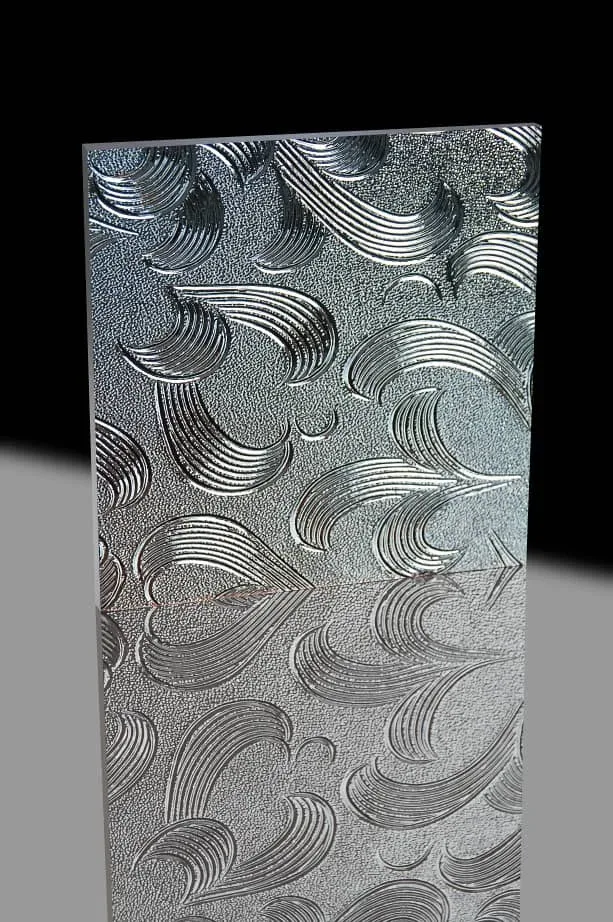
The fundamental engineering distinction between patterned glass and satin glass lies in their primary manufacturing physics. Patterned glass is created mechanically while the glass ribbon is still molten, utilizing engraved steel rollers to impress macroscopic three-dimensional relief features—such as linear flutes, geometric grids, or organic stipples—directly into the cooling glass ribbon during continuous rolling.
In marked contrast, satin glass begins as an optically flat, polished sheet of float glass. One or both faces are immersed in an aqueous bath containing controlled concentrations of hydrofluoric acid. The chemical solution dissolves microscopic silica particles, creating a fine, evenly distributed satin-matte micro-texture. For complete specifications on both product families, explore our patterned glass and satin glass hubs.
Visual Privacy, View Distortion, and Light Transmission Metrics
Both materials provide excellent privacy, but they accomplish this through completely different optical phenomena. Patterned glass distorts images through geometric refraction: objects immediately behind the pane remain visible as distorted contours, while distance increases optical disintegration.
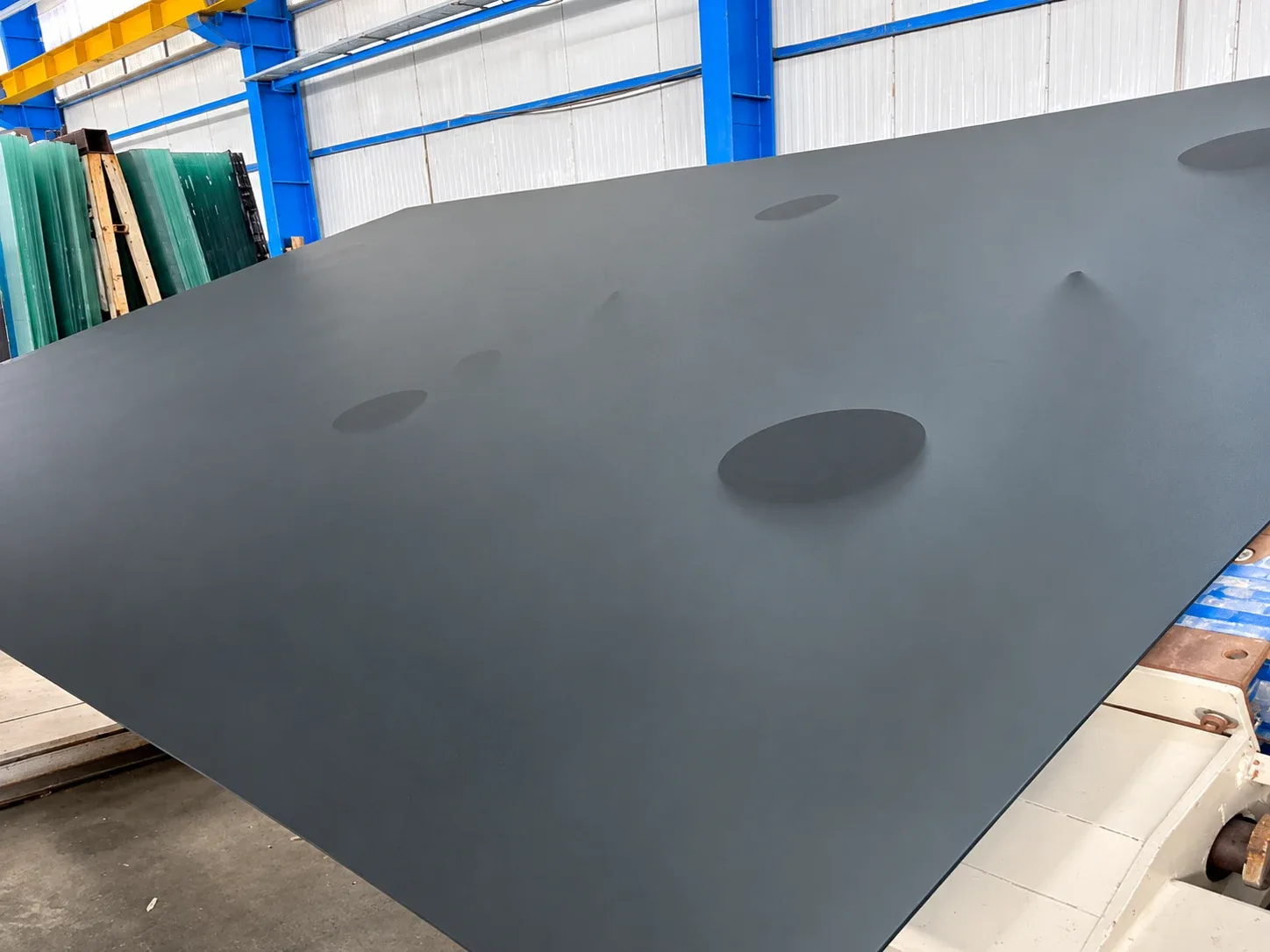
Satin acid-etched glass provides true isotropic diffusion. It scatters incoming light evenly in all directions, creating an opaque frosted appearance where even objects held close to the glass appear as soft silhouettes. Visible light transmittance remains high (typically 80% to 85%), preventing dark interior shadows.
Fingerprint Resistance, Stain Susceptibility, and Daily Maintenance
Daily maintenance is a major consideration for commercial fit-outs and residential hospitality. Traditional sandblasted glass is notorious for absorbing finger oils into open pores, leaving permanent dark smudges that are difficult to clean.
High-quality satin acid-etched glass features a sealed microscopic surface topography that resists fingerprint adhesion and cleans easily with standard neutral glass cleaners. Patterned glass is naturally fingerprint-resistant due to its glossy fire-polished skin, but deep grooves require periodic scrubbing to prevent dirt accumulation along recess lines.
Fabrication Compatibility: Cutting, Toughening, and Lamination
Both glass types can be cut, drilled, edged, and tempered, but processors must respect their distinct surface characteristics during factory handling.
| Rolled Patterned Glass | Acid-Etched Satin Glass | |
|---|---|---|
| Cutting Face | Must score exclusively on the smooth rear face | Can be scored on either etched or smooth face |
| Tempering Furnace Calibration | Requires tuned heating cycles for variable thickness | Standard float tempering cycle (etched face up) |
| Lamination Interlayer Needs | Requires thicker PVB (0.76mm to 1.14mm) for deep grooves | Standard PVB (0.38mm) on smooth side, thicker if etched face in |
| Edge Polishing Speed | Standard feed rate | Standard feed rate with mist cooling |
| Substrate Availability | Standard clear and select tinted bodies | Clear, ultra-clear low-iron, and tinted float bodies |

Acoustic Attenuation and Sound Transmission Class Comparison
In modern open-plan office spaces and executive boardrooms, interior glazed partitions are heavily evaluated for speech privacy and acoustic isolation. A common specification misconception is that surface texturing improves sound dampening. In physical reality, acoustic sound transmission loss is governed almost entirely by the mass and thickness of the glass pane, as described by the acoustic mass law.
A monolithic 6mm patterned pane and a monolithic 6mm satin pane exhibit virtually identical Sound Transmission Class (STC) ratings of approximately thirty-one to thirty-two decibels. When enhanced acoustic privacy is mandated (exceeding thirty-six to thirty-eight decibels), specifiers should laminate the decorative pane with specialized acoustic polyvinyl butyral (PVB) interlayers rather than relying on surface texture.
Architectural Application Matrix for Partitions and Shower Enclosures
Selecting between patterned and satin glass depends on the intended aesthetic theme and privacy requirements of the project. Modern corporate offices frequently specify reeded patterned glass for executive partitions to add linear rhythm, while healthcare and luxury bathrooms favor satin finishes for complete non-directional modesty.
In wet environments such as walk-in shower enclosures, satin glass is specified with the acid-etched face oriented toward the dry exterior side, leaving the smooth glass face exposed to running water. This prevents mineral limescale buildup in the microscopic frosted texture.
Long-Term Durability Under High-Traffic Commercial Glazing Environments
In commercial hospitality, airport lounges, and retail settings, glazing surfaces endure frequent contact with baggage, cleaning carts, and aggressive janitorial disinfectants. Because acid-etched satin glass is an integral modification of the silica network rather than an applied organic film or lacquer, it exhibits the same high chemical resistance as raw float glass, withstanding alcohol-based and neutral enzymatic sanitizers without surface degradation.
Patterned glass similarly exhibits excellent mechanical resistance due to its smooth fire-polished surface skin. However, in exterior facades subject to windborne sand or urban pollution, the horizontal valleys of fluted glass require regular scheduled washing to prevent dust accumulation that could obscure optical clarity over multi-year operational lifespans.
Procurement Checklist and RFQ Specification Guidelines
When requesting quotations for mixed container loads of decorative and frosted glass, ensure your tender package clearly identifies edge requirements, processing states, and surface orientation. Submit your project requirements through our RFQ request portal for immediate technical validation.
- Substrate base: standard clear float versus ultra-clear low-iron for pure white diffusion.
- Texture definition: pattern design name (e.g. Reeded, Chinchilla) versus satin acid-etched level.
- Sheet dimensions and square meter quantities per crate.
- Fabrication scope: annealed stock sheets versus cut-to-size fully tempered panels.
- Surface orientation marking on protective corner protectors.
- Seaworthy wooden crate packaging with moisture-barrier wrapping.

Frequently asked questions
Is satin acid-etched glass more expensive than patterned glass?
Satin glass typically carries a moderate price premium over standard patterned glass because it requires an additional chemical processing stage performed on high-quality float glass sheets, whereas patterned glass is textured directly during primary forming.
Does satin glass turn transparent when wet?
When water fills the microscopic pits of an acid-etched surface, the refractive index differential between glass and air is temporarily neutralized, making the glass semi-transparent until the water dries. Installing the etched surface away from water prevents this phenomenon.
Can satin glass be produced on low-iron ultra-clear glass?
Yes. Acid-etching low-iron glass removes the greenish edge cast common in standard float glass, producing an ultra-clean, pure white frosted appearance that is highly prized in luxury residential and retail display applications.
Which glass type offers superior acoustic insulation?
Acoustic attenuation between monolithic patterned and satin glass of identical thickness is virtually identical, as sound transmission loss is governed by mass and thickness rather than surface texturing.
Can patterned glass and satin glass be combined in a single insulating unit?
Yes. In exterior privacy windows, an insulating glass unit can incorporate an outer clear or low-emissivity pane with an inner patterned or satin pane, providing both thermal insulation and visual obscurity.
Sources
- EN 572-2: Glass in building — Basic soda lime silicate glass products — Part 2: Float glass — European Committee for Standardization
- ASTM C1036: Standard Specification for Flat Glass — ASTM International