
Wired glass and tempered safety glass serve fundamentally different architectural functions, yet they are frequently confused in commercial procurement. While wired glass incorporates an internal steel wire mesh specifically designed to hold shattered glass in place during fire exposure, fully tempered glass is heat-treated to resist high mechanical impact and crumble into small, blunt fragments upon breakage. This guide details their structural mechanics, building code boundaries, and specification rules.
Structural Construction: Embedded Wire Mesh vs Thermal Surface Pre-Stress
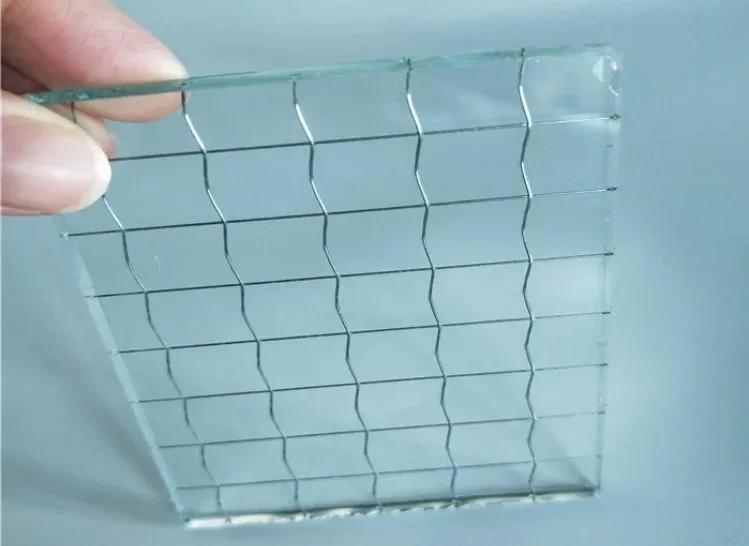
Wired glass is produced by feeding a welded steel wire grid directly into the molten glass ribbon during continuous rolling. The resulting annealed monolithic sheet contains an embedded metal matrix. The wire mesh does not increase the mechanical impact strength of the glass; in fact, it introduces localized stress points into the silica matrix that slightly reduce tensile breaking strength compared to standard annealed glass.
Tempered glass, by contrast, contains no metal inserts. It is manufactured by heating finished float glass panels to approximately six hundred and fifty degrees Celsius and rapidly quenching the surfaces with high-pressure air streams. This locks the outer surfaces into high permanent compression (exceeding sixty-nine megapascals), creating an exceptionally strong safety product. Explore our dedicated wired glass and tempered glass product hubs.
Mechanical Impact Safety and Breakage Hazard Profiles
The breakage behavior of these two materials could not be more divergent. When wired glass is struck with sufficient mechanical impact, it fractures easily like ordinary annealed glass, creating sharp, pointed shards. Although the wire mesh holds the shards in place, severe human impact can push limbs through the fractured pane, causing severe lacerations on exposed jagged wires.
Tempered glass resists mechanical impact up to five times greater than annealed glass. When broken by extreme impact, the stored internal strain energy releases instantaneously, causing the entire pane to fracture into thousands of small, relatively harmless granular cubes without sharp dagger edges.
Pendulum Impact Testing Protocols and Safety Glazing Standards
International safety glazing codes evaluate mechanical resistance using standardized pendulum impact tests (such as European twin-tyre drop tests or North American pendulum impactor protocols). Under these protocols, test impactors weighing fifty kilograms are dropped from heights ranging from two hundred to twelve hundred millimeters.
Monolithic wired glass generally fails Category II impact tests because the glass breaks at low drop heights and allows impalement hazards through the broken wire matrix. Fully tempered glass of equal thickness easily achieves Class 1 (highest safety tier), making it the legally required choice for doors, sidelights, and low-level glazing subject to human collision.
Fire Barrier Behavior: Flame Integrity vs Radiant Heat Transfer
The primary traditional purpose of wired glass is fire barrier containment. Under the rapid thermal shock of a building fire, ordinary float glass and standard tempered glass quickly fracture and fall out of their framing, opening vents that fuel the fire with fresh oxygen and allow flames to spread into adjoining corridors.
Wired glass also fractures under fire temperatures, but the steel mesh holds the shattered pieces firmly inside the frame. This maintains a physical barrier that prevents the passage of smoke, toxic gases, and flames (fire integrity rating), allowing occupants to safely evacuate escape stairwells.

Cutting and Fabrication Feasibility at the Jobsite
Fabrication limitations strongly dictate how these products are managed on commercial job sites.
| Wired Glass (Annealed) | Fully Tempered Glass | |
|---|---|---|
| Mechanical Impact Resistance | Low (similar to standard annealed float) | Very High (4 to 5 times annealed strength) |
| Breakage Pattern | Large shards held together by internal wire grid | Small granular, blunt cubes |
| Fire Barrier Integrity (Smoke/Flames) | Maintains opening barrier during fire exposure | Falls out of frame when thermal limit is exceeded |
| Site Cutting and Drilling | Possible with specialized scoring and wire snips | Strictly impossible; causes instant total shattering |
| Edge Corrosion Susceptibility | High if cut wires are unsealed in humid zones | Zero; homogenous glass edge |
Building Code Compliance and Common Specification Misconceptions
Modern international building codes have significantly revised the allowable applications for traditional wired glass. In many jurisdictions, traditional wired glass is prohibited in hazardous human impact locations such as gymnasium doors, low-level windows, and school corridors unless it is laminated with an impact-resistant polymer safety film.
For fire doors requiring both twenty-to-ninety minute fire integrity and certified human impact safety, specifiers must carefully assess local building codes to ensure the specified glazing complies with both safety and fire resistance mandates.

Procurement Comparison Matrix and Architectural Selection Rules
When preparing procurement tenders, never substitute tempered glass for wired glass, or vice versa, without formal approval from the project structural engineer and local fire authorities. Submit your project requirements through our RFQ portal for tailored component delivery.
- Confirm primary design objective: fire barrier integrity versus human impact safety.
- Verify required thickness: standard 6mm for wired glass; 4mm to 19mm for tempered glass.
- Establish dimensions: stock sheets for factory cutting versus finished tempered sizes.
- Edge polishing requirements: mandatory polished/sealed edges on wired glass to prevent rust.
- Certification submittals: request valid impact safety and fire test classification reports.
- Container packing: timber crates lined with moisture barriers and corner cushioning.
Frequently asked questions
Can wired glass be tempered to increase its impact strength?
No. The steel wire mesh has a different thermal expansion coefficient than the glass and acts as an internal stress concentrator. Subjecting wired glass to a tempering furnace causes spontaneous shattering during the cooling quench.
Does wired glass provide insulation against radiant heat during a fire?
No. Wired glass provides fire integrity (blocking flames and smoke), but it does not block radiant heat transfer. Temperatures on the unexposed face will rise rapidly, potentially igniting nearby combustible materials.
Why does wired glass rust along the edges?
When wired glass is cut, the steel wire ends are exposed. If edges are not ground smooth and sealed, ambient moisture causes the wire to rust, creating dark stains and structural weakness along the glass perimeter.
Can tempered glass be used in fire-rated doors?
Standard tempered glass cannot be used in fire-rated openings because it shatters completely when exposed to severe fire differentials. Only specialized ceramic or multi-layer intumescent fire glazing meets fire barrier standards.
What is film-backed wired glass?
Film-backed wired glass features a heavy-duty clear polyester or polypropylene safety film factory-laminated to one or both faces. This enables the wired glass to achieve impact safety certification while retaining its fire integrity barrier performance.
Sources
- EN 12150-1: Glass in building — Thermally toughened soda lime silicate safety glass — European Committee for Standardization
- ASTM C1036: Standard Specification for Flat Glass (Wired Glass Category) — ASTM International