
Tempered glass is a safety material created by subjecting annealed float glass to controlled thermal treatments, resulting in a product with significantly higher mechanical and thermal strength. This guide explains the toughening process, the resulting internal stress profile, fabrication constraints, and the specific architectural and commercial applications where this material excels or falls short.
What tempered glass is
Tempered glass, frequently referred to as toughened safety glass, is a processed material designed to offer superior mechanical and thermal resistance compared to standard annealed float glass. While annealed glass cools slowly to relieve internal stresses, tempered glass undergoes a deliberate secondary thermal treatment that introduces a highly controlled, permanent stress profile into the pane.
Surface compression changes how tempered glass responds to load and breakage. The process does not change its basic chemical composition or weight, but optical effects and performance vary with processing. Whether tempered glass is appropriate for impact, wind or thermal exposure depends on the project specification and applicable safety rules.
How toughening works: heating and rapid cooling
The manufacturing of tempered glass begins with pre-cut and edge-finished annealed glass. The panes are washed to remove any microscopic debris that could cause optical defects or surface blemishes during the heating phase. Once clean, the glass is loaded onto a roller hearth furnace.
Inside the furnace, the glass is heated to a very high temperature, approaching its softening point. At this stage, the material becomes pliable but does not melt or lose its overall shape. The critical phase follows immediately: the hot glass is transferred to a quenching section where high-pressure air blasts are directed uniformly across both surfaces.
This rapid cooling chills the exterior surfaces much faster than the interior core. As the outer layers cool and contract, they solidify. Meanwhile, the core remains hot and pliable for a fraction longer. When the core finally cools and attempts to contract, it is restricted by the already rigid outer surfaces. This differential cooling rate locks the pane into a state of permanent internal stress.
Stress layers and breakage patterns
The quenching process creates two distinct stress zones within the pane. The rapidly cooled exterior surfaces are locked in a state of high compression, while the slower-cooling interior core is held in a state of high tension. It is this surface compression that gives tempered glass its remarkable resistance to mechanical impacts and thermal shock. Any external force must first overcome the compressive layer before it can propagate a crack.
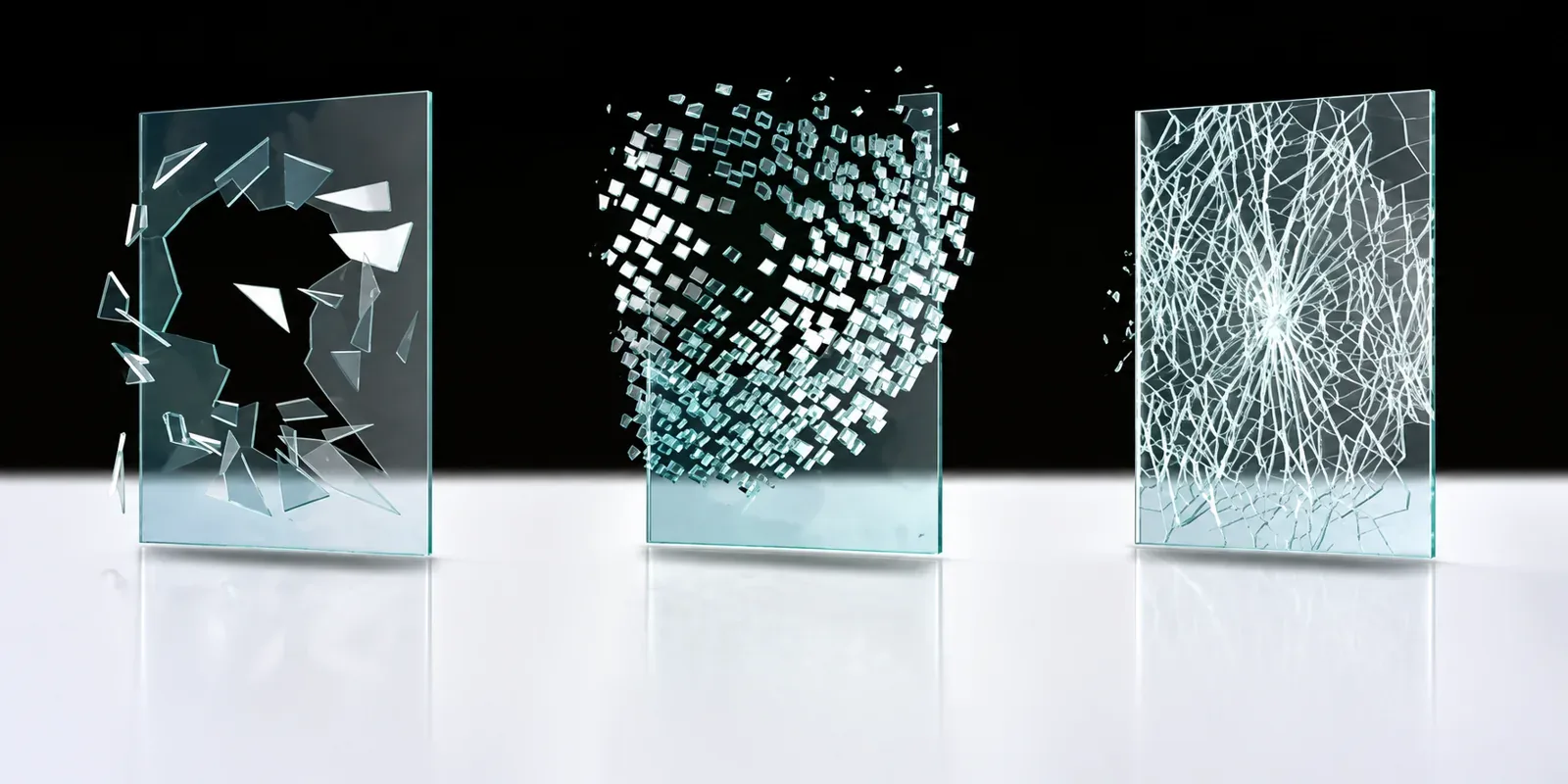
Stored stress governs how tempered glass breaks. A fully tempered pane generally fragments into relatively small pieces when it fails, which can reduce some laceration risks but does not make the fragments harmless. Its remaining barrier function depends on the system; a monolithic pane should not be assumed to retain a fall-protection role after breakage.
| Annealed Glass | Tempered Glass | |
|---|---|---|
| Internal Stress | Relatively low after annealing | Surface compression and core tension |
| Mechanical Resistance | Baseline for the comparison | Generally increased for equivalent glass |
| Thermal Stress | Depends on glass and conditions | Generally improved versus equivalent annealed glass |
| Breakage Pattern | Typically larger sharp fragments | Generally smaller fragments; injury remains possible |
Fabrication limits: what cannot be done after tempering
The most critical operational constraint for processors and installers is that tempered glass cannot be altered after the quenching process. All cutting to size, drilling of holes, notching, and edge polishing must be completed while the glass is still in its annealed state.
Attempting to score, cut, or drill tempered glass will instantly disrupt the delicate balance between the compressive surfaces and the tension core. The moment a tool breaches the compressive layer, the stored energy is released, causing the entire pane to explode into granular fragments. This absolute limitation requires precise planning, accurate field measurements, and flawless communication between the architectural design team and the fabrication floor before the glass enters the furnace.
Furthermore, the quality of the edge work prior to tempering directly influences the final strength of the pane. Micro-cracks or deep scratches left on the edges during the cutting phase act as stress concentrators. When the glass is subjected to the intense thermal cycles of the furnace, these edge defects can cause the pane to shatter inside the equipment or result in a finished product with compromised structural integrity.
Sizing, thickness and edge finishing
The physical dimensions and thickness of the glass dictate the specific parameters of the tempering cycle. Thinner panes require highly precise temperature control and faster quenching to achieve the necessary stress profile without introducing excessive optical distortion. Thicker panes absorb more heat and require longer soaking times to ensure the core reaches the target temperature before quenching begins.
Edge finishing is equally vital. While seamed edges are acceptable for hidden or framed applications, exposed edges in frameless assemblies require flat polishing or arrising to remove microscopic flaws. The chosen edge profile must be specified before the toughening process begins.
Where tempered glass is used and where it falls short
Tempered glass is used in many architectural and commercial applications. Its breakage pattern can reduce some injury risks, but suitability depends on the applicable impact classification and whether the installed assembly must remain a barrier after breakage.
A monolithic tempered pane generally loses its barrier function when it fragments. For overhead glazing, sloped facades and fall-protection applications, assess the risk of glass fall-out and the required post-breakage behavior of the complete assembly. Do not assume either that every fragment will fall out or that the opening will remain protected.
Procurement teams must carefully evaluate the specific risks of the installation site. When both impact resistance and post-breakage retention are required, fabricators often combine the two technologies by tempering the individual plies before laminating them together. For a deeper analysis of these trade-offs, refer to our guide on laminated vs tempered glass. If you are evaluating options for a specific project, our overview on how to choose glass type and thickness provides further structural context.
Frequently asked questions
Can tempered glass be cut or resized on the construction site?
No. Tempered glass cannot be cut, drilled, or edged after the toughening process. Any attempt to alter the pane will breach the compressive surface layer, causing the entire sheet to shatter instantly into granular pieces. All sizing and hole drilling must be completed during the initial fabrication stage before the glass enters the tempering furnace.
Why does tempered glass sometimes break spontaneously without impact?
Spontaneous breakage is rare but can occur due to microscopic nickel sulfide inclusions trapped within the glass matrix during the original float manufacturing process. These inclusions can change phase over time, expanding slightly and disrupting the internal tension core. Edge damage sustained during handling or installation can also act as a stress concentrator, eventually leading to failure.
Is tempered glass suitable for overhead or sloped glazing?
A monolithic tempered pane generally loses its barrier function when it fragments, so it should not be assumed suitable by itself where overhead glass fall-out must be controlled. Select and verify the complete glazing system, including any laminated component, against the applicable project and local requirements.
How does the tempering process affect the optical quality of the glass?
Tempering can introduce optical effects such as roller wave or anisotropy, especially visible under some viewing conditions. Assess the allowable appearance and tolerances for the specified product and installation rather than assuming a universal optical result.
How does edge quality affect the final strength of the tempered pane?
Edge quality is critical. The edges of a glass pane are its most vulnerable points. If the edges are left rough or contain micro-cracks from the cutting process, these flaws will act as stress concentrators during the intense thermal cycles of the furnace. This can cause the glass to break inside the furnace or result in a finished product with significantly reduced mechanical strength.