
Selecting glass type and thickness requires reviewing loads, support, applicable safety requirements and the intended appearance together. The final configuration should be checked for the specific installation rather than selected from a universal thickness rule.
Start with the job the glass has to do
Every glazing project begins with a functional mandate. Before evaluating specific materials, define the primary job the glass must perform. Is it serving as a weather barrier in a high-rise facade, a safety barrier in a commercial balustrade, or an interior partition in a busy office? The application dictates the baseline performance requirements.
Exterior glazing must withstand significant wind loads, thermal cycling, and potential impact from debris. Interior glazing prioritizes acoustic separation, human impact resistance, and visual transparency. Procurement teams and fabricators must align the material specification with these environmental and functional demands to avoid premature failure or unnecessary costs.
Furthermore, consider the framing system. A fully supported four-sided frame distributes stress differently than a two-sided or point-fixed structural glazing system. The support method directly influences the required rigidity and, consequently, the necessary thickness and type of glass. Point-fixed systems, for instance, concentrate stress around the fixings, often requiring specialized heat-treated glass with precise hole placements.
Safety requirements: when laminated or tempered is the right call
Where human impact, fall protection or overhead glazing is involved, identify the applicable local safety requirements and the performance expected after breakage. Tempered and laminated constructions address different risks; neither should be selected from its breakage description alone.
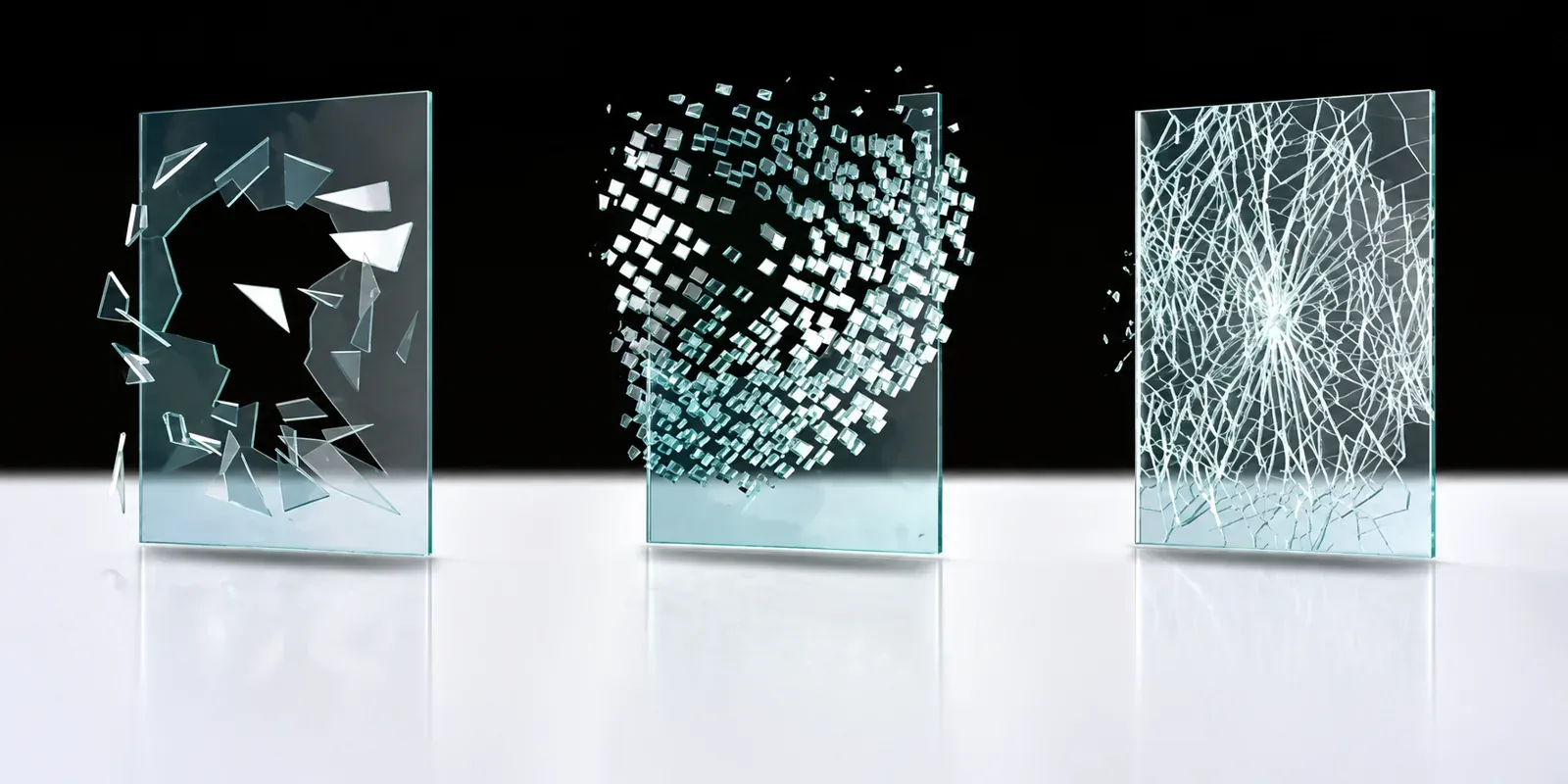
Heat-treated glass develops surface compression during processing. Fully tempered glass generally breaks into relatively small fragments, which can reduce some injury risks but does not make a broken pane harmless or preserve a barrier. Review the tempered glass guide for fabrication and selection limits.
A laminated interlayer can retain broken fragments. Whether the installed glazing remains a protective barrier depends on the build-up, framing, fixings, loads and damage scenario. For overhead glazing or balustrades, the complete assembly must be assessed against the project requirements. See the laminated versus tempered comparison.
Aesthetics and solar control: clear, tinted, reflective or ultra-clear
Beyond structural and safety performance, the visual and thermal behavior of the glass profoundly impacts the building's design and energy profile. Standard clear glass provides high visible light transmission but carries a slight greenish tint due to iron content. For applications demanding true color rendering, such as retail displays or high-end architectural facades, ultra-clear glass is preferred. By reducing the iron content, it offers exceptional transparency and neutral edges. Browse the ultra-clear glass options for demanding visual fidelity.
Tinted glass incorporates colorants during production to absorb solar radiation, reducing glare and heat gain while providing a distinct exterior appearance. However, because it absorbs heat, it is more susceptible to thermal stress and may require heat treatment in certain climates or when partially shaded.
Reflective glass uses a coating to change light and solar performance. Its effect on heat gain and privacy depends on the coating, glazing build-up and lighting conditions; thermal insulation must be evaluated for the complete unit. Review the reflective glass family for available options. For uncoated applications, the float glass family remains a processing base.
Determining thickness: size, support, load and safety
Glass thickness is selected from pane dimensions, glass composition, support conditions and design loads. Both stress and deflection must be checked. A larger or less-supported pane may need a different build-up, but no single thickness rule applies without the whole system and project loads.
In safety applications, thickness is also driven by the need to absorb impact energy. A balustrade must resist a concentrated horizontal force, necessitating a robust, often laminated, construction. The cumulative build-up in laminated or insulated units must also be considered, as interlayers and gas cavities add to the overall profile, which must fit within the designated glazing pocket.
When specifying thickness, always consult with structural engineers to verify that the chosen configuration meets the local wind load and deflection limits for the specific building height and exposure. Consult our float glass FAQ for foundational material properties and baseline behaviors.
Sheet sizes, cutting optimization and supplier coordination
Glass is produced in large sheets and cut to size. The choice of sheet size impacts both yield and logistics. Producers offer standard sheet sizes as well as jumbo formats. Jumbo sheets are advantageous for large facade panels, minimizing the need for splicing and reducing waste for big-cut sizes. However, they require specialized handling equipment, larger transport vehicles, and specific unloading infrastructure at the destination.
Cutting optimization is crucial for cost control. Procurement teams should work with fabricators to nest cut sizes efficiently within the available sheet dimensions. For coated or reflective glass, edge deletion is often required before assembling into insulated units to ensure sealant adhesion, which slightly reduces the final visible area and must be accounted for during the nesting process.
Coordinating with the supplier early in the design phase ensures that the requested dimensions align with the producer's manufacturing capabilities. Learn more about regional supply chains and production capabilities in our overview of float glass factories and suppliers in Iran.
Preparing your request for quotation
A precise request for quotation prevents delays, miscommunications, and costly rework. When approaching a supplier or fabricator, provide a comprehensive specification package that leaves no room for ambiguity. Clear documentation ensures that the quoted price accurately reflects the required processing and material costs.
Ensure your documentation includes the following critical elements to facilitate an accurate and prompt response:
- Glass Type and Configuration: Specify whether the requirement is monolithic, laminated, or an insulated glass unit, including the exact makeup of plies, interlayers, and cavities.
- Dimensions and Tolerances: Provide exact width and height, noting which dimension is the primary orientation, along with acceptable dimensional tolerances.
- Edge Work and Fabrication: Detail the required edge profile, the presence and location of holes or notches, and any specific corner treatments.
- Coatings and Tints: Specify the exact coating type, its position within an insulated unit, and any required edge deletion zones.
- Quantities and Packaging: State the total area or piece count, and specify packaging requirements for safe transit to your specific region.
Submit your detailed requirements through our request for quotation portal to initiate the procurement process and receive tailored pricing for your project.
Frequently asked questions
Can I use standard clear glass for large exterior windows?
Clear float glass can be used in exterior glazing when the complete assembly meets the project’s wind, thermal and safety requirements. Pane size alone does not determine thickness; support, exposure, glass build-up and deflection limits also matter.
Does thicker glass always mean it is safer?
Not necessarily. While greater thickness improves impact resistance and structural rigidity, it does not change the breakage pattern of annealed glass, which still shatters into sharp, dangerous shards. True safety requires heat-treated or laminated glass, which alters how the material behaves upon failure, regardless of its overall thickness.
How do I choose between tinted and reflective glass for solar control?
Tinted glass absorbs solar heat, which reduces glare but can lead to thermal stress if the glass is partially shaded. Reflective glass bounces solar energy away from the building, offering better thermal insulation and daytime privacy. The choice depends on the building's orientation, local climate, and whether heat absorption or reflection is preferred for the HVAC load.
What is the maximum size of glass I can order?
The maximum size is constrained by the producer's jumbo sheet capabilities, the transport logistics to your region, and the handling equipment available at the installation site. While manufacturers can produce very large sheets, moving and installing them requires specialized cranes and suction lifters, which often dictates the practical maximum size for a project.
Do I need to specify edge work for laminated glass?
Specify the required edge finish in the drawings and confirm that it is available for the selected product. Exposed edges may call for different finishing or protection than framed edges; interlayer moisture and sealant compatibility require product-specific guidance.